Description
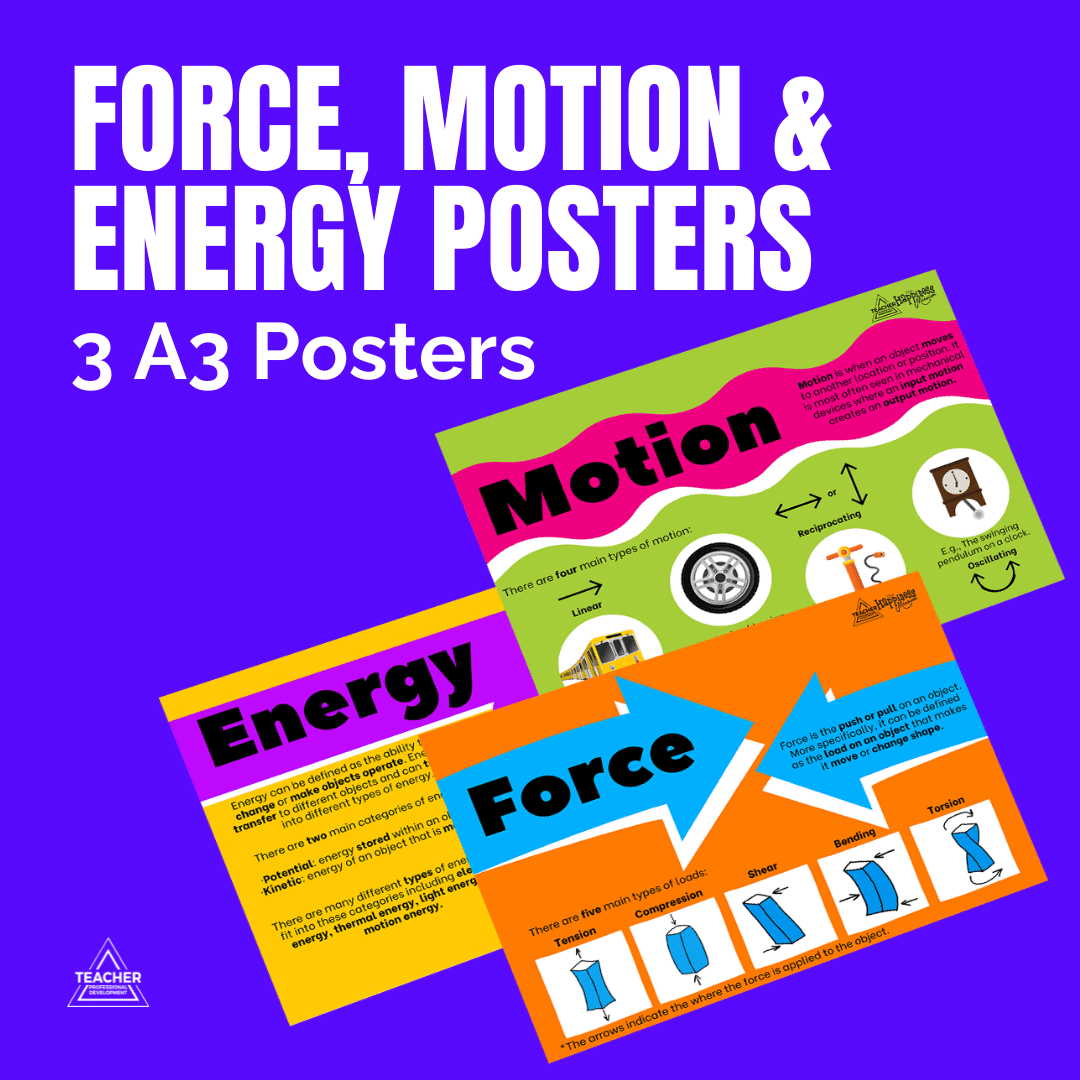
These force, motion and energy posters will help you create a colourful classroom that will enhance student learning. Use these bright and engaging posters to decorate your classroom. The A3 posters can be printed, laminated and displayed in your classroom for students to use as visual cues when completing activities.
Each poster provides information on force, motion and energy using text and graphics to assist visual learning styles.
Pack includes:
Relevant to:
ACARA Australian Curriculum Design & Technologies YRS 7-10
ACTDEK031 Analyse how motion, force and energy are used to manipulate and control electromechanical systems when designing simple, engineered solutions
ACARA Australian Curriculum Science Years 7-10
ACSSU117 Change to an object’s motion is caused by unbalanced forces, including Earth’s gravitational attraction, acting on the object
ACSSU155 Energy appears in different forms, including movement (kinetic energy), heat and potential energy, and energy transformations and transfers cause change within systems
NSW NESA Technology Mandatory Years 7-8 Syllabus (2017)
Engineered Systems
› explains how force, motion and energy are used in engineered systems TE4-8EN
- investigate how force, motion and/or energy are utilised when designing engineered systems, for example: (ACTDEK031)
- electronic circuits
- mechanisms involving simple machines
- built environments
- produce products or systems that apply engineering principles, for example: (ACTDEK031, ACTDEP039) DT
- a product that applies force, motion and/or energy for a purpose, eg toys, windmill
NSW NESA Science and Technology K-6 Syllabus (2017)
Early Stage 1
STe-5PW-ST observes the way objects move and relates changes in motion to push and pull forces
Physical World
- observe the effects of push and pull forces on familiar objects, for example: (ACSSU033) SciT
- changes in motion, eg starting, stopping, changing speed or direction
- changes in shape, eg stretching, breaking
- participate in guided investigations to explore how particular objects move on land, water and/or in the air, and how these objects are affected by forces (ACTDEK002) SciT
Stage 1
ST1-8PW-S describes common forms of energy and explores some characteristics of sound energy
ST1-9PW-ST investigates how forces and energy are used in products
Physical World
Forces and energy in products
Focus question: How are forces used for a purpose?
Students:
- explore how technologies use forces to create movement in products (ACTDEK002) SysT
- design and develop a product that uses one or more forms of energy to create change DesT
Stage 2
ST2-8PW-ST describes the characteristics and effects of common forms of energy, such as light and heat
ST2-9PW-ST describes how contact and non-contact forces affect an object’s motion
Physical World
Contact and non-contact forces
Inquiry question: How can objects affect other objects with or without touching them?
Students:
- identify that both pushes and pulls can be classified as contact and non-contact forces
(ACSSU076)
- observe how contact and non-contact forces cause changes in the motion of objects, for example: (ACSSU076)
- changes in speed
- changes in direction
Forces and energy in products and systems
Focus question: How can we use forces and energy in a product or system?
Students:
- investigate how forces and materials interact in a product or system to perform a function (ACTDEK011) ComT SciT SysT
Stage 3
ST3-8PW-ST explains how energy is transformed from one form to another
ST3-9PW-ST investigates the effects of increasing or decreasing the strength of a specific contact or non-contact force
Physical World
Describing and exploring specific forces
Inquiry question: How can we make a force stronger or weaker?
Students:
- explore and describe some common contact or non-contact forces, for example:
- applied force (eg pushing, kicking)
- friction and air resistance
- tension and elastic force
- gravity
- magnetism
- buoyancy
- perform a scientific investigation to explore the effects of changing the strength of a single contact or non-contact force, for example: SciT
- how a stronger or weaker applied force, such as a push or kick, results in objects travelling longer or shorter distances
- how increasing or decreasing the strength of the force of air resistance by changing the shape of an object results in increases or decreases in speed
Transfer and transformation of energy
Inquiry question: What types of energy transformations can be observed?
Students:
- identify different types of energy transformations, for example: (ACSSU097)
- gravitational energy to energy of movement
- heat energy to light energy
- investigate how electrical energy can be transferred and transformed in electrical circuits and can be generated from a range of sources (ACSSU097) SciT SysT
Forces and energy in products and systems
Focus question: How can electricity be used in a product or system?
Students:
- describe examples where light, sound, heat and electrical energy transform from one type of energy to another, for example: ComT SysT
- a toaster transforms electrical energy into heat energy
- a microphone transforms sound energy into electrical energy
- a solar panel transforms light energy into electrical energy
- investigate how electrical energy can control movement, sound, or light in a product or system (ACTDEK020) ComT SciT
- design, test and evaluate a product or system that involves an energy transformation to meet an identified need using electrical energy ComT DesT
NSW NESA Science Years 7-10 Syllabus (2018)
Stage 4
SC4-10PW describes the action of unbalanced forces in everyday situations
Stage 5
SC5-10PW applies models, theories and laws to explain situations involving energy, force and motion
Industrial Technology 7-10 Syllabus (2019)
Engineering
NSW NESA Engineering Studies Stage 6 Syllabus (2011)
NSW NESA Physics Stage 6 Syllabus (2017)
QLD QCAA Physics General Senior Syllabus (2019)
TAS TASC Physics
SA SACE Stage 1 Physics Subject Outline (2021)
SA SACE Stage 2 Physics Subject Outline (2021)
WA SCSA Physics Year 11
WA SCSA Physics Year 12
Vendor Information
The Happiness Mission has been creating and delivering resources and Teacher PD since 2016.
Our mission is to arm teachers with effective time-saving resources and skills, so they can enjoy work-life balance. We want exceed the expectations of our teachers – because teachers go above and beyond in the classroom every day. And for that we say, thank you!

 The Happiness Mission



 MRS.S
MRS.S
 Lovius Educational Consultancy