Description
Get your students aboard the sustainability train through the exploration of the environmental impacts of textiles.
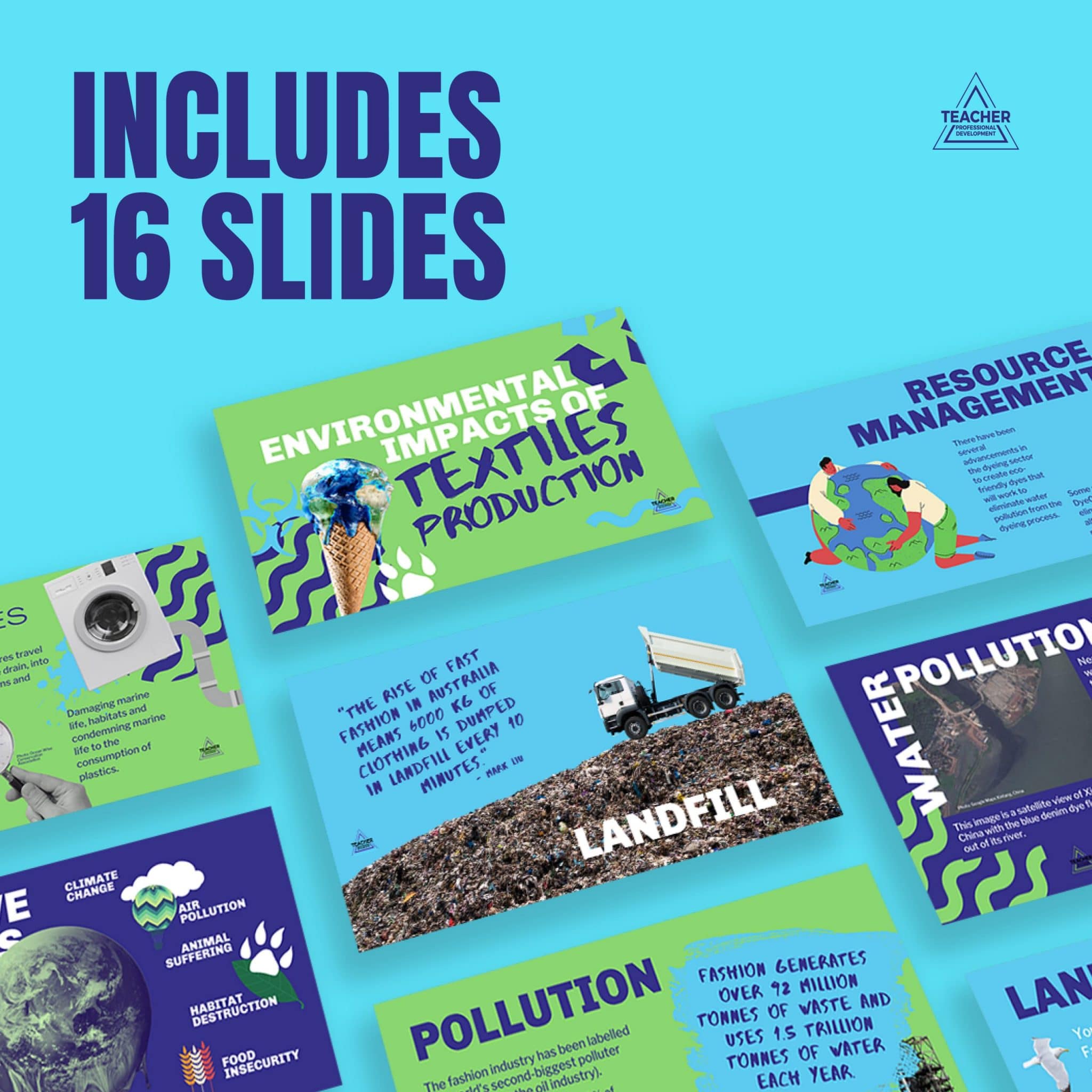
Use this resource to guide your students through a variety of environmental impacts, including:
- Water Pollution and Depletion
- Climate Change
- Habitation Deconstruction
- Landfill & Pollution
- Microfibres
Explore contemporary innovative solutions that involve recycled fibres and natural dyeing techniques.
This resource includes a PowerPoint presentation and student worksheets that go hand in hand. You can use this resource to facilitate a whole class collaborative approach, or you can set students up to use this resource as an opportunity for autonomous learning.
Teacher instructions are also provided to give you clarity. This resource can be differentiated at your discretion based on the needs of your students.
Pack includes:
- 16 Slide PowerPoint
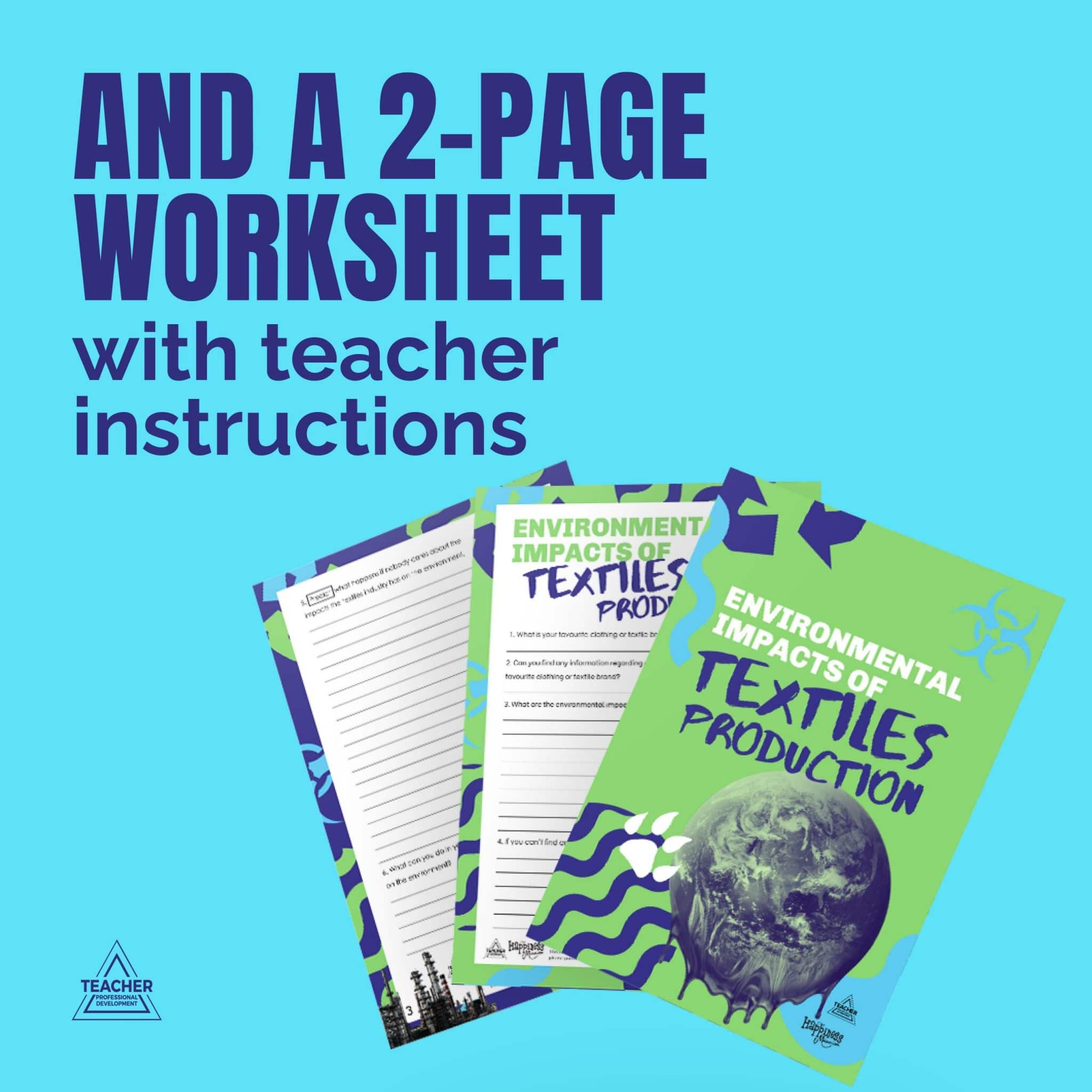
- 2-Page Student Worksheet
- Teacher Instructions
NSW NESA TEXTILES TECHNOLOGY 7–10 SYLLABUS (2019)
- investigate the potential impact textiles production has on the environment, for example: (ACTDEK044)
- pollution, eg fast fashion’s contribution to landfill
- recycling, eg plastic bottles recycled to make fabrics
- resource management, eg reducing toxic chemicals used in the dyeing process
VIC Product Design and Technology 2020
Unit 1: Sustainable product Redevelopment
Area of Study 1: Sustainable redevelopment of a product
Outcome 1
Key knowledge
- the environmental, economic and social impacts associated with the origin/source, manufacture, use and disposal of products
- impacts of unsustainable products and resource use on environmental, social and economic systems
Unit 2: Collaborative design
Area of Study 1: Designing within a team
Outcome 1
Key Knowledge
- economic, environmental and social issues of sustainability related to design
Unit 4: Product development and Evaluation
Area of Study 1: Product analysis and comparison
Outcome 1
- environmental, economic and social issues associated with products that may be of concern and consequence to potential purchasers and end-user/s.
WA Yr11 Materials Design Technology Syllabus ATAR 2016 GD
- investigate environmental impact of the textile industry
- growing, extraction and processing
- manufacturing, packaging, and distribution
- end-of-life of a product – recycling and safe disposal
WA Yr12 Materials Design Technology Syllabus ATAR 2016 GD
- impact production, processing and use of textiles has had on society and the environment:
- historical impact
- current impact
Vendor Information
The Happiness Mission has been creating and delivering resources and Teacher PD since 2016.
Our mission is to arm teachers with effective time-saving resources and skills, so they can enjoy work-life balance. We want exceed the expectations of our teachers – because teachers go above and beyond in the classroom every day. And for that we say, thank you!



 The Happiness Mission


 Lovius Educational Consultancy