Description
Research has shown that grounding techniques are effective in assisting children in developing self-regulation in times of emotional crises.
The attached article clarifies the benefits and outlines the various approaches to grounding.
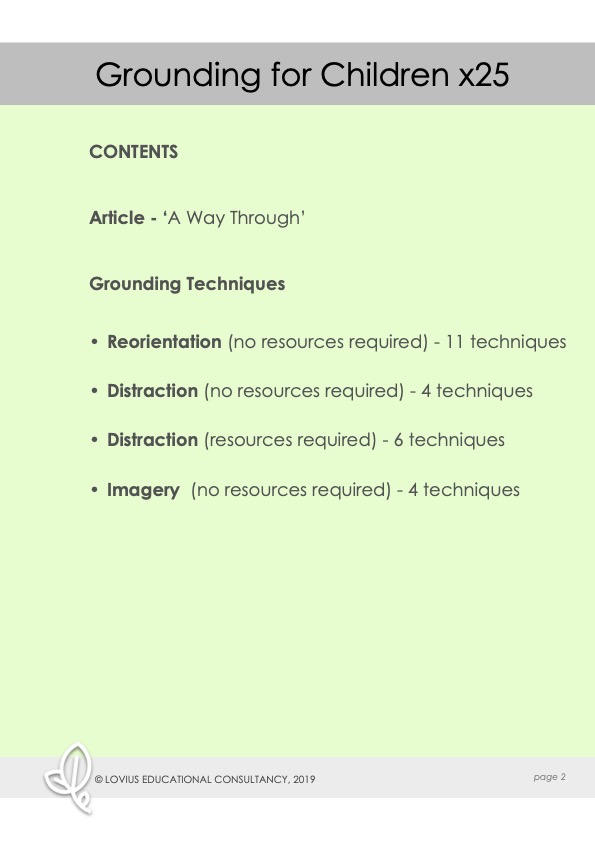
Included here are twenty-five strategies that are suitable for children to implement independently. The majority of them require no resources and a few require resources that are readily available in any classroom or home.
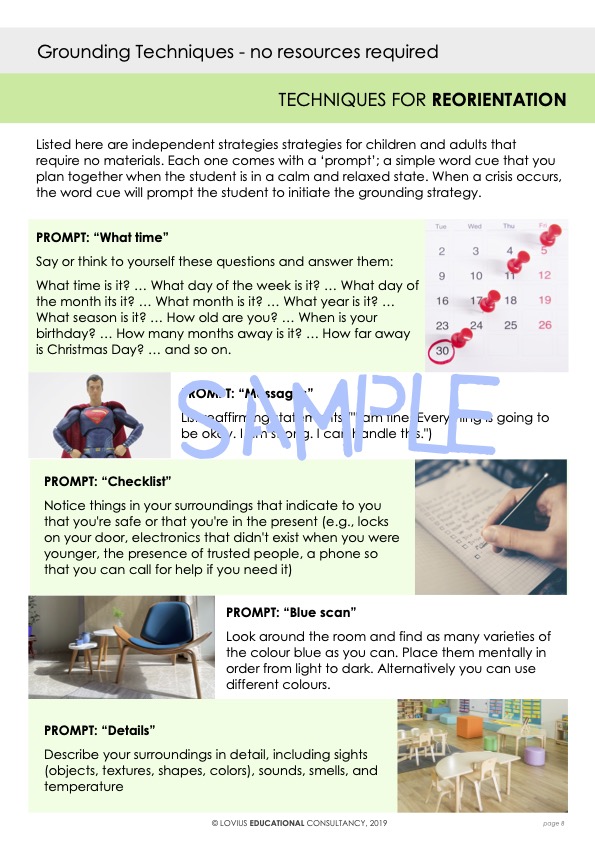
It is important to note that this strategies are best implemented in a state of calm and negotiated or co-planned with the child.
They are at their most effective when they have been practised multiple times, outside of a crisis moment. When a crisis moment arrives, the child or adult can use the ‘prompt’ or word cue to remind the child of the strategy.
Vendor Information
After 20+ years of teaching in primary and secondary schools, Juliette Watts (née Lovius) realised traditional classrooms often fail to support many children, causing them to feel 'dumb' for not achieving in standardised assessments.
Seeking to understand more about challenging educational contexts, Juliette earned two Masters Degrees in Human Rights and Education, and International Development Education. Her research took her to Ireland, The Netherlands and East Africa, where she explored how children’s brains can adapt and learn even in traumatic situations.
In 2011, she founded Lovius Educational Consultancy, creating Flourish Tutoring - a program harnessing the brain's ability to form new connections to help struggling children succeed and build self-esteem. Now based in Australia, Juliette works with schools, families and communities, focusing on non-traditional educational strategies.
The resources Juliette creates for Lovius Educational Consultancy are rigorously researched and repeatedly tested in classrooms. Her goal is to support teachers to provide meaningful and differentiated learning opportunities with maximum effect on students and minimal drain on teacher time.


 Lovius Educational Consultancy





 The Happiness Mission